- Swingly
- Posts
- How To Play CPI Today
How To Play CPI Today
In partnership with


MARKET ANALYSIS
Here’s What You Need To Know
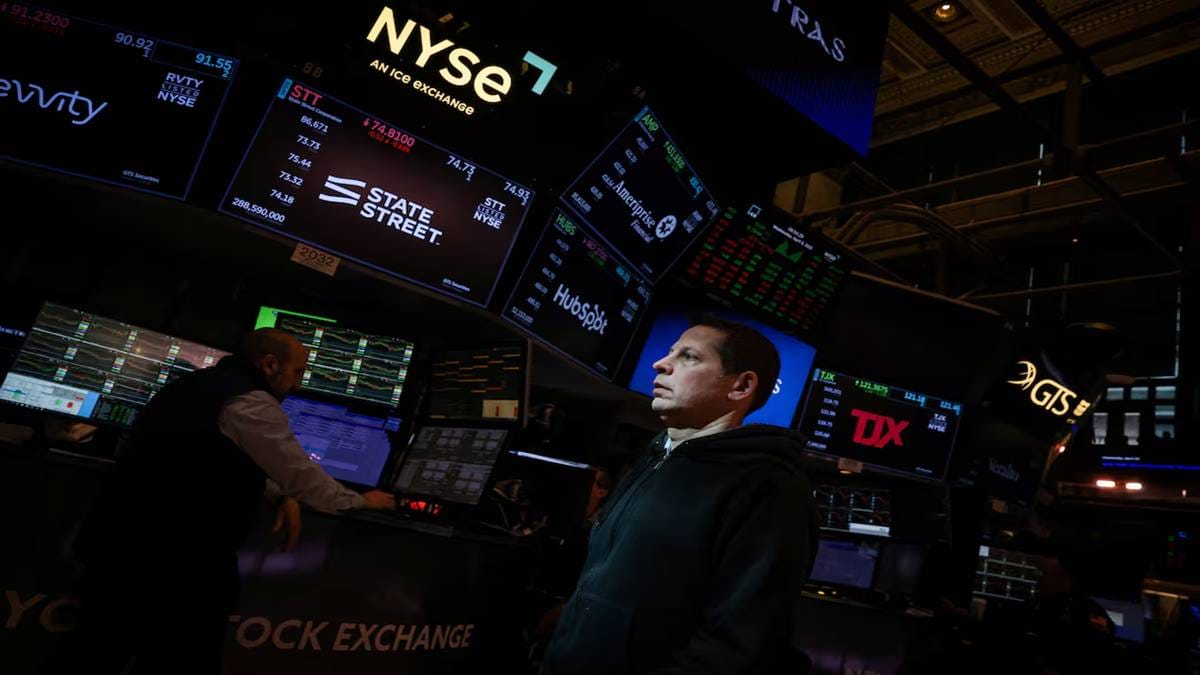
U.S. futures are slightly lower this morning as markets digest yesterday’s sharp selloff and position ahead of the January CPI report, which is expected to show inflation running at 2.5% year over year and 0.3% month over month.
Thursday’s session was a meaningful risk-off move, with the S&P 500 falling nearly 1.6%, the Nasdaq dropping about 2%, and the Dow losing roughly 670 points, as weakness in large-cap technology spilled across sectors.
The pressure was broad within mega-cap tech, with every member of the “Magnificent Seven” closing lower, including a 5% decline in Apple and a 12% slide in Cisco following disappointing guidance.
The stronger-than-expected January jobs report earlier this week, which showed 130,000 payroll additions and a dip in the unemployment rate to 4.3%, has complicated the Federal Reserve outlook by reducing recession fears while potentially delaying rate cuts.
A CPI print that comes in above expectations would likely reinforce the “higher for longer” rate narrative and put additional pressure on growth equities, while a softer reading could trigger a reflex rally in oversold segments of the Nasdaq.
Beneath the surface, the AI theme is becoming more selective rather than collapsing outright, as companies like Applied Materials surged double digits on strong earnings, reinforcing that hyperscaler capital expenditure remains robust.
Major technology firms are projected to spend more than $600 billion combined this year on capital expenditures, up sharply from roughly $350 billion last year, suggesting that AI infrastructure investment is not being pulled back despite volatility in equity prices.
International markets are mixed following the U.S. selloff, and even traditional safe-haven currencies have shown instability over the past year, reinforcing that we are operating in a structurally higher volatility regime.

Nasdaq

QQQ VRVP Daily & Weekly Chart

QQQE VRVP Daily & Weekly Chart
47.52%: over 20 EMA | 48.51%: over 50 EMA | 51.48%: over 200 EMA
For traders who’ve been following this report over the past week, you know we’ve been closely tracking the descending broadening wedge forming in the QQQ — and the same structure in the equally weighted QQQE.
This pattern is statistically significant in bull markets, where descending broadening wedges most often resolve with upside breakouts after sufficient touch points.
According to Bulkowski testing across roughly 800 simulations, once you reach five meaningful trendline touches, upside breakouts occur about 83% of the time, while downside breakdowns only occur around 32% of the time.
We currently have four clean touch points, which means the structure is approaching statistical viability but has not fully completed.
Yesterday’s rejection at 615–617 was precise and aggressive. It came on 150% relative volume, coinciding with rejection of the declining 10-week moving average near 616 and a breakdown through the 10-, 20-, and 50-day moving averages.
The intraday range in QQQ was 2.8%, versus a normal ADR of 1.6%, meaning volatility expanded to roughly 1.75x its typical daily range. That expansion, paired with elevated volume, confirms real participation.
QQQE mirrored the move almost identically. It printed a 2.6% range (roughly 2x its ADR) with relative volume surging to 240% of average. While QQQE is less liquid and more volatile, it serves as a useful gauge to strip out mega-cap distortion — and both structures are moving in tandem.
Both ETFs are now pressing toward potential tests of their 200-day EMAs. For QQQ, that is roughly a 2.9% downside move. For QQQE, closer to 1.9%.
The key takeaway really is that while the structure looks vulnerable short term, statistically these formations in bull markets still favor upside resolution, once the upper boundary breaks.
Until then, this remains a defined range trader’s structure with very clear supply and demand boundaries.
S&P 400 Midcap

MDY VRVP Daily & Weekly Chart
56.78%: over 20 EMA | 65.57%: over 50 EMA | 66.58%: over 200 EMA
The mid-caps were the most extended capitalization group over the past several weeks, with breadth readings repeatedly pushing above 70% of stocks over their 20- and 50-day moving averages. That extension finally resolved lower yesterday.
MDY printed a 3.5% intraday range, more than 2.2x its normal daily range, on 125% relative volume. That combination of volatility expansion and rising participation signals real distribution.
At the highs near 660, visible range volume showed roughly 62,000 shares traded red versus only 14,000 green — clear supply dominance.
More importantly, between 653 and 647 — the zone price sliced through aggressively — volume was heavily skewed toward prior buying. Around 650, roughly 80,000 shares traded green versus 50,000 red. Between 647–650, approximately 100,000 green versus just 20,000 red. Those buyers are now underwater.
When price returns toward that zone, it is highly probable those trapped buyers supply the market at break-even. That creates overhead friction and makes sharp V-shaped recoveries less likely without a strong catalyst.
With CPI pending and volatility elevated, gap moves — in either direction — should not be blindly trusted. The first hour of trading in this environment is statistically unstable, especially after a volatility expansion day like yesterday.
Russell 2000

IWM VRVP Daily & Weekly Chart
45.80%: over 20 EMA | 52.90%: over 50 EMA | 62.07%: over 200 EMA
The small caps are continuing to validate their Adam and Eve double top structure. The first peak (Adam) formed between January 21–23, and the second rounded top (Eve) formed between February 6–12.
Yesterday’s breakdown occurred on 130% relative volume with a 3.6% range — roughly 2x its normal daily range. That confirms expanding participation as price weakens.
For the pattern to fully confirm, IWM must break below the valley low near 255, which would require another ~1.8% downside move. That breakdown would also coincide with failure of the 50-day EMA and the rising 10-week moving average — both of which have held since the November Morningstar reversal.
Until 255 breaks, the structure is developing but not fully validated. However, given that mid-caps — the leadership group in risk-on capital flows — have already begun unwinding, the pressure on small caps is increasing.
You're overpaying for crypto.

Every exchange has different prices for the same crypto. Most people stick with one and pay whatever it costs.
CoW Swap checks them all automatically. Finds the best price. Executes your trade. Takes 30 seconds.
Stop leaving money on the table.
FOCUSED GROUP
XLV: Healthcare & Pharma Continue To Base

XLV VRVP Daily & Weekly Chart

XPH VRVP Daily & Weekly Chart
At this stage, most groups — including defensives — are technically extended or structurally unstable. The one area that continues to show relative resilience is healthcare.
XLV is contracting while holding its rising 50-day EMA and bouncing precisely at its rising 10-week moving average. The broader structure remains a relatively fresh Stage 2 advance that began in September 2025.
Weekly ATR is compressing over the last several weeks while the broader market becomes more erratic. Volatility contraction in isolation is constructive — it implies energy is building.
This compression creates asymmetry. A breakdown below the 10-week moving average near 154 would offer a high-probability short trigger. Conversely, a breakout from this contraction could resolve higher with momentum expansion.
Healthcare’s largest weighting is pharmaceuticals (~30%+). XPH is also contracting, holding its rising weekly 10 EMA and printing higher lows. Relative volume has steadily declined as price compresses — a clear volatility contraction signature.
In an environment where most sectors are expanding in volatility, contraction stands out. That does not guarantee direction, but it does offer cleaner structural setups compared to extended defensive sectors or collapsing growth segments.
Did you find value in today's publication?This helps us better design our content for our readers |
Reply